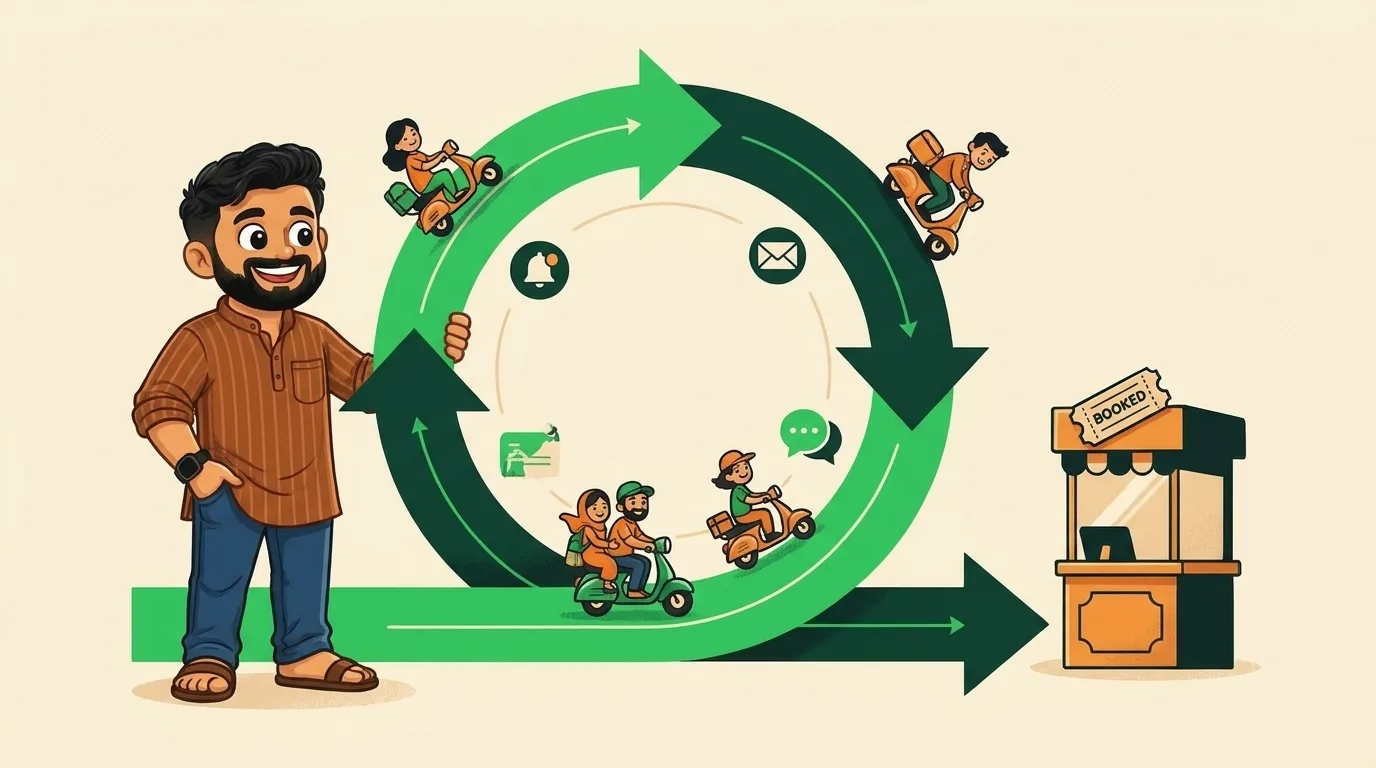
Acquiring a customer is expensive. Bringing back one who already trusts you is cheaper, faster and compounds every month. Yet most companies treat retention as "send an offer email on Sunday". Here is the retention marketing system I run for millions of travellers — and what I'd do at any consumer business.
Retention vs acquisition: why retention wins long term
Paid acquisition gets more expensive every year as more brands bid on the same audience. Retention does the opposite: every improvement — a better trigger, a cleaner segment, a smarter coupon — keeps paying back on your whole customer base. That is why I lead with retention and use performance marketing to keep filling the top.
1. Build on behaviour triggers
Good retention responds to what a customer just did. Every important moment in the journey becomes a trigger with its own message:
- Searched, didn't book → reminder with the same route and date
- Dropped at payment → fast, helpful nudge, no discount by default
- First trip done → welcome back with a personal return coupon
- Quiet for 60–90 days → a win-back with a real reason to return
- Regular traveller → early alerts before peak fares
2. Pick the channel for the moment
Every channel has a job. Push is for right now. WhatsApp is for things that matter — it gets read. Email carries detail and costs almost nothing. SMS and RCS cover users who are hard to reach elsewhere. The skill is sequencing them so a customer hears from you once, in the right place, rather than five times everywhere.
“Retention isn't about sending more messages. It's about sending the one message that makes someone come back.”
3. Audit your discounts
Coupons are the most expensive retention tool, and they leak. When I matched three months of bookings against coupon history, 43% of one public return-trip code's discount was going to people it was never meant for. The fix was personal, single-use coupons issued automatically after each booking. Same intent, a fraction of the leakage.
4. Measure with holdouts — always
Retention metrics lie easily because loyal customers come back anyway. Every campaign I run keeps a random group that gets nothing, and the real impact is the extra bookings over that group. Across 145+ experiments, holdouts are what told us which ideas to scale and which to kill quietly.
5. Own the stack
Tools like CleverTap are great for orchestration, but the moment you want something the vendor doesn't support, you're stuck. I built our own retention CRM server — WhatsApp AI agent, ticketing desk, a cross-brand opt-out register and real-time event pipelines — so the retention team can ship an idea in days, not quarters.
Your retention checklist
- Map the 5–7 key moments in your customer journey
- Give each moment one trigger, one message and one channel
- Replace public coupons with personal, expiring ones
- Keep a holdout on every campaign
- Review results weekly and kill what doesn't beat control